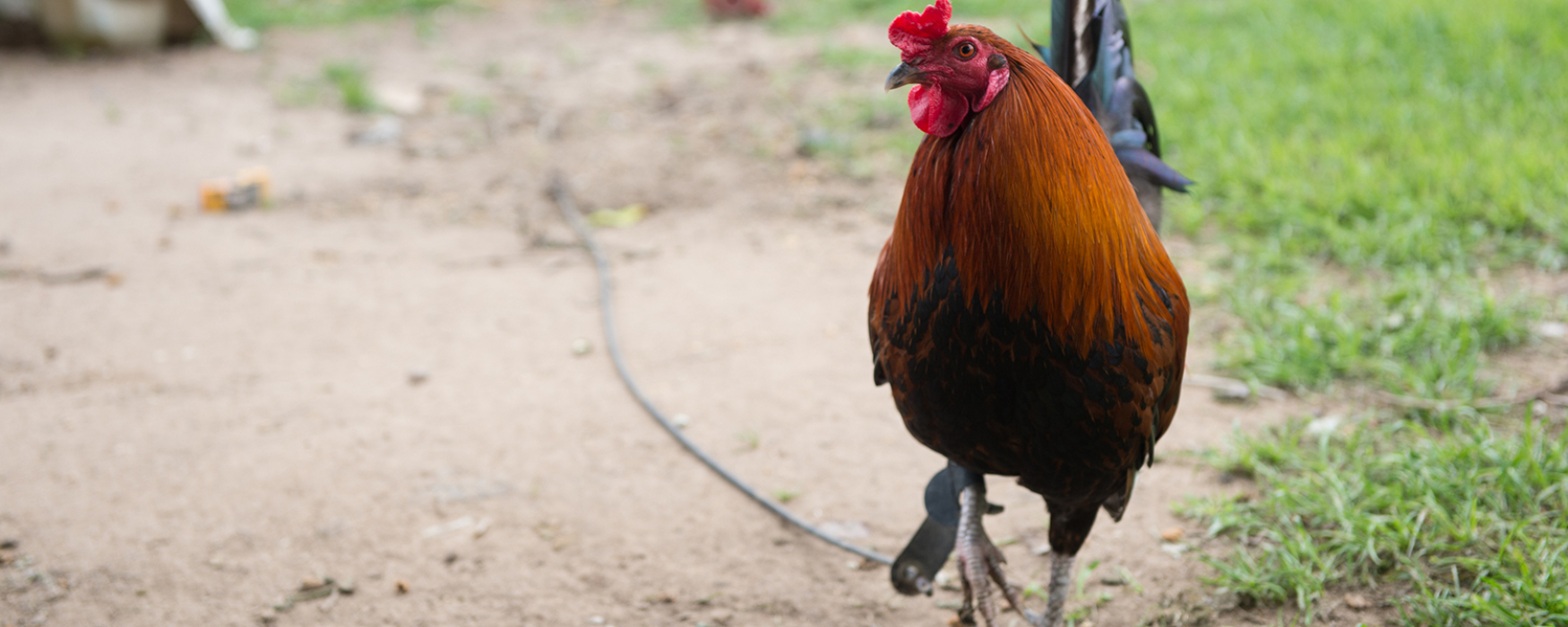
In Oklahoma, cockfighting’s corrupting influence was conspicuously evident in this election cycle. It featured not one but two state office seekers who were proudly soft on this bloodiest of blood sports, which is illegal under federal law and state laws throughout the nation.
It’s comforting to know that good judgment prevailed, while these two candidates did not.
Justin Humphrey, the House District 19 incumbent, was running for the office of Lieutenant Governor. As a state representative, he led a failed attempt to weaken penalties for cockfighting, a felony crime under Oklahoma law. In doing so, he worked closely with the gamefowl breeding industry, a public face for Oklahoma’s underground animal fighting subculture.
Seeking to fill Humphrey’s seat was Anthony Devore, onetime head of the Oklahoma Gamefowl Commission, a now-defunct cockfighters’ political action committee whose name disguised its true nature and its purpose: to undermine cockfighting penalties. On his website, Devore promised to “promote public safety by being tough on crime and work to raise minimum sentencing for violent and heinous crimes.” This from a candidate who pleaded no contest last spring to the crime of spectating at a cockfight after video footage documenting his presence at one came to light.
Having lost their bids, one would hope, Humphrey and DeVore will now give up their pipe dream of downgrading their state’s anti-cruelty provisions concerning animal fighting. Both know that voters in Oklahoma banned cockfighting by a double-digit margin in 2002, that its felony-level penalties are well-aligned with similar prohibitions in neighboring states, and that even if elected officials there could successfully decriminalize it, cockfighting would still be a felony-level crime—in Oklahoma and every other state—under federal law.
At the same time, Humphrey and Devore also know that with enhanced criminal penalties in place for two decades Oklahoma remains a functional safe haven for cockfighting, with opportunities that match the depravity involved. The state’s gamefowl breeding interests are understood by many to be a part of an organized network that sells breeding stock and the tools and implements of cockfighting in the global marketplace.
To mask their true goal, the gamefowl crowd comes up with one evasion after another. claiming that their enthusiasm and their businesses are not about cockfighting, but about bird fancy, agricultural research, and the absolute right of Oklahomans to breed roosters and supply the needs of agricultural producers across the globe.
These arguments are undeserving of response, and the fact remains that, in Oklahoma, where they already flout state and federal laws, cockfighting interests have directly engaged in efforts to compromise if not to subvert state government itself, by seeking political office. Humphrey and Devore are living proof of this point.
Too many people think of cockfighting as an innocuous activity. They shouldn’t. It’s a social evil infused with violence that is justly reviled not only in the United States but worldwide. It’s not a “victimless” crime, either. Its explicit object—encouraging hyperaggressive birds to gouge, hack, puncture and wound one another in fights to the death—contradicts standards of decency and empathy for other creatures, and it demeans and diminishes us all.
The organized political engagement of individuals and interests who promote this sort of animal cruelty is why the work done by Humane World Action Fund is so critical. The animal protection movement must continue to oppose the candidacy of those seeking to undo fundamental animal protection measures—and elect and re-elect animal protection advocates to every level of public office. The law is on our side, the wind is at our backs, and we won’t give any ground in public policy or the public arena to the supporters of animal fighting and other cruelties.