An explainer about the Endangered Species Act, common misconceptions about human-bear interactions, and why grizzly bears need to be protected in the Lower 48 states
WASHINGTON (August 12, 2026)—The grizzly bear population in the Lower 48 states, along with decades of conservation progress and billions of dollars in public investment, is at serious risk because of a July 2026 announcement by the U.S. Department of the Interior that it intends to turn grizzly bear management over to the states. Following the announcement, the U.S. Fish and Wildlife Service formally proposed policy changes to how grizzly bears are protected under the Endangered Species Act.
Additionally, some members of Congress are pursuing legislation to remove federal protections for grizzly bears by bypassing the Endangered Species Act's science-based review process (H.R. 281/S. 316), while appropriations riders (H.R. 9171) would further erode safeguards for the species. There are also broader efforts underway by lawmakers to weaken the ESA (H.R. 1897) that would undermine scientific decision-making, critical habitat protections and judicial oversight as part of the law’s framework under which imperiled species have been protected for the last half century.
“For more than 50 years, the Endangered Species Act has protected grizzly bears and countless other species from extinction. Today, those protections are under attack. Grizzly bears face habitat loss and human-caused mortality, and they live in small, isolated populations that do not allow for sufficient genetic diversity. With fewer than 2,000 grizzly bears remaining in the Lower 48 states, this is no time to weaken federal protections,” said Kitty Block, president and CEO at Humane World for Animals.
Key facts about grizzly bears in the United States
- The Endangered Species Act helped save grizzly bears from extinction. Grizzly bears were one of the species that inspired the passage of the Endangered Species Act in 1973 and were listed as threatened soon afterward. Under the law, a threatened species is one that is likely to become endangered in the foreseeable future across all or a significant portion of its range.
- Grizzly bears have not yet recovered from the killing campaigns that brought them to the brink of extinction. Once an estimated 50,000 to 100,000 grizzly bears roamed the contiguous United States. Today, fewer than 2,000 remain in isolated populations in Montana, Idaho and Wyoming, occupying only about 6% of their historic range. Conservation biologists warn that the increasingly limited genetic diversity of these small and disconnected grizzly bear populations threatens to reduce the species’ long-term survival and resilience.
- Grizzly bears reproduce more slowly than most mammals. Grizzly bears do not reach adulthood until they are 4 to 8 years old. Females typically have litters only every three to four years, and it can take about 10 years for a single female to replace herself in the population. As a result, the loss of even a small number of bears can impede or prevent population recovery.
- Both 2024 and 2025 saw record-level mortalities for grizzly bears living in the Greater Yellowstone Ecosystem, as bears must roam farther to find food when key sources dry up. It promises to be difficult for bears to find food in the national parks and elsewhere this summer and fall after a tremendous drought in the Northern Rocky Mountains (Idaho, Montana and Wyoming) where all Lower 48 grizzly bears live.
- Most Americans support protecting grizzly bears. Polling has found broad bipartisan support—including among residents of grizzly bear states and supermajorities of conservatives, ranchers and hunters—for maintaining federal protections under the Endangered Species Act.
- Grizzly bears are an economic asset for Western communities. Beyond their ecological importance, grizzly bears contribute significantly to local economies through wildlife tourism. A 2025 analysis found that grizzly bear viewing in Yellowstone is valued at approximately $6.9 million annually, with each bear contributing an estimated $46,000 per year to the regional economy.
- Human-grizzly bear conflicts are rare and preventable. Thousands of people safely recreate in grizzly country each year, and attacks occur in fewer than 1% of documented encounters. Most conflicts result from unsecured attractants (primarily food) or surprise encounters. Such conflicts can be avoided through proven measures such as carrying bear spray, securing food and trash, hiking in groups and— in agricultural contexts—using electric fencing to protect domestic animals. Coexistence strategies work, and they help to keep both people and bears safe.
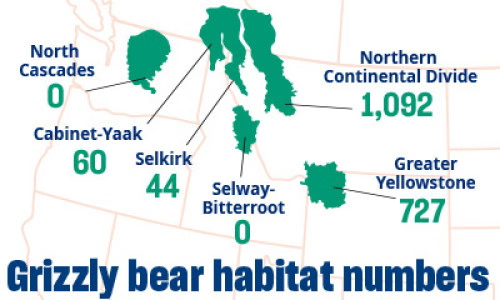
Source: Graphic adapted from C. L. Shafer, Conservation Genetics Resources, Springer Nature, 2022
Timeline: A decade’s worth of back and forth in the courts and the federal government on grizzly bear protections
- Summer 2017 – U.S. Fish and Wildlife Service prematurely removed federal ESA protections from Greater Yellowstone area grizzly bears, handing management authority to Idaho, Montana and Wyoming. State wildlife officials launched plans to allow trophy hunters to legally kill up to two dozen grizzly bears, and Humane World for Animals and its legal partners sued to challenge the delisting.
- August and September 2018 – We won two important victories in our lawsuit against the U.S. Fish and Wildlife Service. First, a federal court blocked planned trophy hunts in Wyoming and Idaho and then later restored Endangered Species Act protections for Greater Yellowstone grizzly bears. The U.S. Fish and Wildlife Service and other defendants appealed the ruling to the Ninth Circuit Court of Appeals.
- July 2020 – The Ninth Circuit Court of Appeals issued a unanimous opinion upholding the 2018 court victory that returned grizzly bears in the Greater Yellowstone Ecosystem to the federal list of threatened species. This positive ruling was a result of consolidated lawsuits filed in 2017 by Humane World for Animals, allied conservation organizations and native American tribes.
- April 2021 – Under a new presidential administration, the U.S. Fish and Wildlife Service announced some good news: Grizzly bears in the Lower 48 states would retain their current protections under the Endangered Species Act.
- February 2023 – The Biden administration announced that certain populations of grizzly bears warranted a status review, which meant that the federal government would consider removing Endangered Species Act protections. In response, Humane World for Animals and Humane World Action Fund organized nearly 100,000 comments opposing the delisting of these grizzly bear populations.
- January 2025 – In one of the last wildlife-focused actions taken by the Biden administration, the U.S. Fish and Wildlife Service announced that it would not prematurely remove ESA protections for the largest populations of grizzlies in the Lower 48 states, but that rule was never finalized.
- July 2025 – The House Natural Resources Committee greenlit the Grizzly Bear State Management Act (H.R. 281) for a full House vote in the future. This bill, and its Senate counterpart, would direct the U.S. Fish and Wildlife Service to delist the Greater Yellowstone Ecosystem grizzly bear and block judicial review of this action, a move that would strip Americans of their right to hold the government accountable in federal court.
- January 2026 – Good news from Capitol Hill as Congress discarded dangerous policy riders offered by the House of Representatives that targeted Endangered Species Act protections for grizzly bears.
- June 2026 – The House Appropriations Committee advanced a funding bill with more than 20 anti-wildlife policy riders, including language directing the Department of Interior to delist grizzly bears from the Endangered Species Act, which would push this already vulnerable species closer to the brink of extinction.
- July 2026 – The U.S. Fish and Wildlife Service proposed major changes to endangered species protections for grizzly bears in the Lower 48 states, transferring management of their populations to the very states that have consistently hostile to them, while leaving the door open for a grizzly bear delisting in the future.
Download Photos/Video of grizzly bears
Media Contact:
- Rodi Rosensweig, Humane World for Animals, (202) 809-8711, rrosensweig@humaneworld.org
- Liz Bartolomeo, Humane World Action Fund, (240) 742-0475, ebartolomeo@humaneaction.org