By Brad Pyle
Whether it’s establishing a bond with a newly adopted pet or fighting for hallmark animal protection legislation, good things take time. With that in mind, we have been building up our political programming in recent years, because we know that bringing an end to animal cruelty is possible when we unite, organize, and show up as a movement.
As a 501(c)(4) organization, Humane World Action Fund can endorse candidates for public office, unlike 501(c)(3) nonprofit entities, including the majority of those working in the animal protection sector. That is why we have been able to organize the largest network of animal-focused political action committees in the country. That capacity, combined with our overall advocacy model, has strengthened our impact as an effective force for animals at all levels of government and in every election cycle.
The expansion of Humane World Action Fund’s influence in state and local politics began in earnest in 2018. Since then, in more than thirty states, we have made a combination of independent political expenditures and published candidate endorsements, policy questionnaires, state humane scorecards, and voter resources to foreground animal issues and recruit and educate candidates.
We’ve founded state-focused political action committees in sixteen states to date—part of an effort to ensure humane candidates have the financial resources they need to run winning campaigns. As election day 2026 approaches, let’s take stock of just how far our advocacy has come and how the political tools we have developed have made a difference in every state in which we are active. A second blog will highlight how we work to elect and re-elect candidates to office who share our values—but first, let's discuss how we identify candidates worthy of our support.
Scorecards
Modeled after our annual federal Humane Scorecard, our state scorecards inform voters about their elected representatives’ legislative records and help to hold those lawmakers accountable for their votes and actions on animal issues. We relaunched state-level scorecards in 2021, and we have successfully issued them in 11 states—Maryland, Illinois, Virginia, Texas, California, Indiana, Iowa, Colorado, Washington, Nevada and Arizona, with several states the subject of multiple scorecards over the years.
Legislators understand that they are being graded on their actions to advance legislation, and in particular through their support for strengthening cruelty statutes, increasing access to veterinary care, addressing extreme confinement of farm animals, expanding pet-friendly housing access, safeguarding wildlife, addressing the cruelties of puppy mills, animal fighting and the fur trade, and more.
To an increasing degree, elected officials are paying attention to their scores. In 2023 our Illinois state director Marc Ayers appeared on NBC Chicago to highlight the issues we graded. In other states, like Maryland and Arizona our scorecards have also received press coverage. On an increasing basis, too, we hear from lawmakers about their pride in earning good scores, and their interest in learning how they can do better the next time around.
Questionnaires that advance the cause
While scorecards serve as an incredibly useful tool in evaluating incumbents and candidates who have previously held elected office, new candidates require additional research—and that's where our candidate questionnaires for state office come in. When we began to circulate them, we surveyed office-seekers in four states on a variety of issues including trophy hunting, pet store sales and factory farming. We received just under 66 responses in total for all four states.
Fast forward to 2024, when we circulated questionnaires in 17 states with over 400 responses returned.
For 2026, we have crafted 29 state level questionnaires and responses from candidates are still coming in from across the country. These communications are indispensable in educating candidates on our priority issues, and in gauging where they stand on policy matters—whether they are long-time incumbents or newcomers.
Endorsements are our seal of approval
Eight years ago, we endorsed only a handful of state and local candidates. In 2024, we endorsed over 500 candidates running for state and local office in 17 states.
One of them was Indiana State Representative Dave Hall (R), and in addition to being a consistent supporter of humane legislation, his example shows why this dimension of our work really counts. Rep. Hall has carried forward important pro-animal measures like HB 1203 (2026), “Sunny’s Research Adoption bill,” to require research laboratories to offer dogs and cats for adoption after their use. He’s also stood tall against pet store preemption bills and the establishment of a bobcat season in his state.
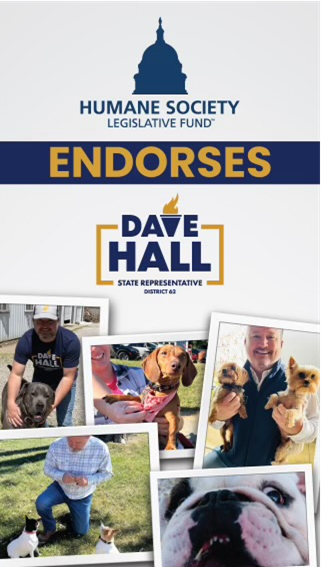
During his last campaign cycle, Rep. Hall publicized his Humane World Action Fund endorsement in his campaign literature and in text messages to voters. He ended up winning re-election by about 800 votes, and we’re confident that our endorsement helped him to present himself to voters as an ally to the cause of animals. As the Assistant Majority Whip in the Indiana House, Rep. Hall is in a position to do still more good for animals in the future.
We’re finding, engaging, and supporting candidates who win, and building relationships that make a difference for animals. You can keep up with this year’s slate of supported candidates by periodically checking our endorsement center—we will update it frequently throughout the year.
Identifying candidates who are deserving of our support is only the beginning of our election efforts. Be sure to check out tomorrow’s blog on how we use our resources to help them win their election.
Brad Pyle is political director of Humane World Action Fund.