By Sara Amundson and Kitty Block
On a cold winter morning in January 1966, state troopers with a search warrant raided the property of an animal dealer in White Hall, Maryland. There, they found scores of dogs in distress, chained to boxes and barrels, jammed into wire pens and chicken crates, mired in their own waste, with no shelter from the elements or the numbing temperatures.
The man who led them onto the property, our animal cruelty investigator, Frank McMahon, had been at this site before. He had been investigating the trade in animals for use in laboratories for five years by that point, helping to lay the foundation for reform.
This time, it was different, because Life Magazine photographer Stan Wayman was there to document the action, and just a few weeks later, in early February, a multi-page photo-essay featuring Wayman’s dramatic images of emaciated dogs in filthy, overcrowded pens blew the issue of pet theft and cruelty in the animal supply trade wide open. Less than a year later, in August, McMahon and other humane advocates stood next to President Lyndon B. Johnson as he signed the Laboratory Animal Welfare Act into law. And McMahon received one of the signing pens.
This week, the Animal Welfare Act, as it is now known, turns 60.
The 1966 law had two main goals: to prevent the theft of America’s dogs and cats for research and testing, and to establish humane standards for the treatment of six species of animals in laboratories: dogs, cats, monkeys, guinea pigs, hamsters, and rabbits.
Today, this historic statute does much more. Over the years, through a series of revisions and amendments, the protective aegis of the AWA has expanded to encompass the treatment of animals not only of certain animals destined for experiments in laboratories, but also in commercial breeding, transportation, animal fighting, public exhibition and trade. Our colleagues past and present have played a role in securing virtually every significant revision in the law’s history, and making it better, broader and more effective is an unshakable priority for us.
That’s because, even with its weaknesses and limitations—and there are many—the AWA reflects an important principle, namely, that institutional animal cruelty is not exempt from public concern or the regulatory scope of government. We are strong believers in this principle, and it animates much of our policy work not just in the United States but throughout the world.
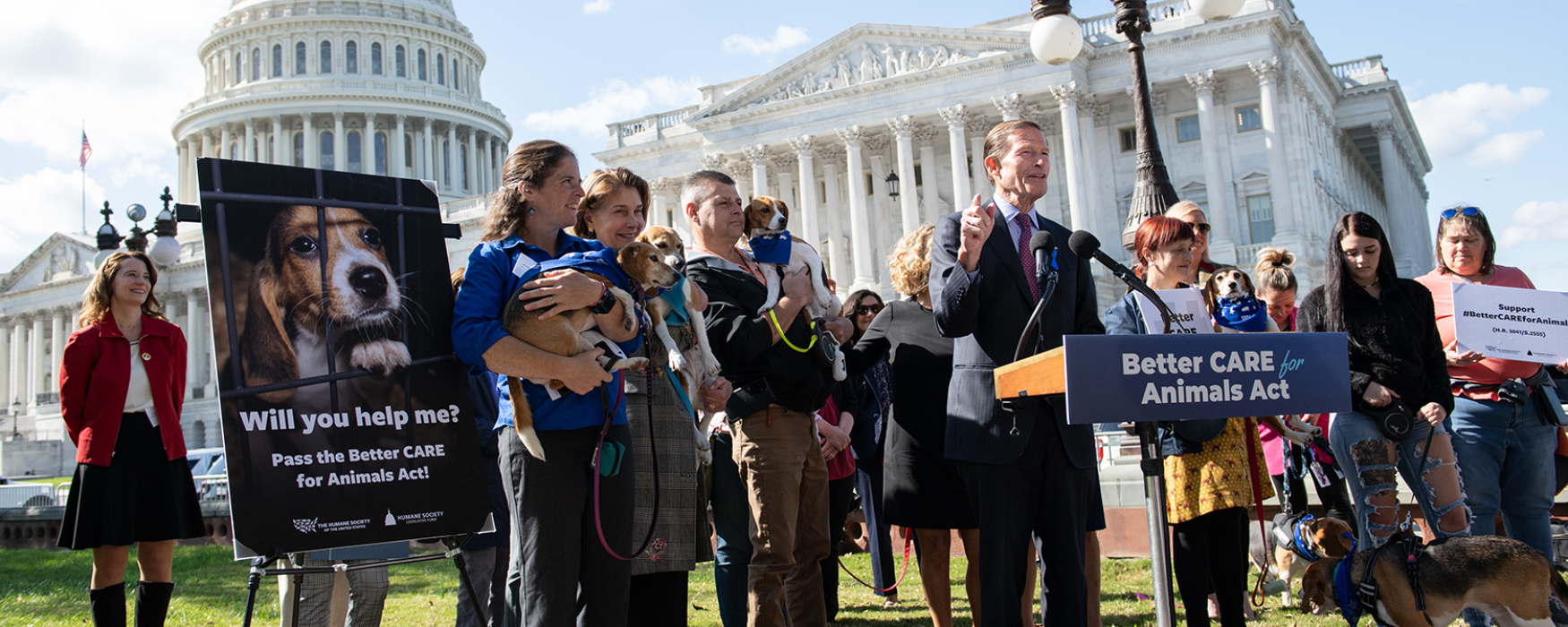
In our own time, in a number of cases, we have seen the power of the AWA to do good. The most storied involved the unprecedented $11 million penalty imposed on the contract laboratory Inotiv in 2024 following a 2022 investigation of its Envigo facility in Cumberland, Virginia that bred dogs for use in experiments. This case brought into focus the value of multi-agency coordination in the enforcement of federal animal welfare laws, something that we would like to see reinforced through wise legislation, like the Better Collaboration, Accountability, and Regulatory Enforcement (CARE) for Animals Act.
Support the Better CARE for Animals Act >>
That measure, which enjoys broad bipartisan support, directly addresses the need for closer cooperation between the U.S. Department of Agriculture and the U.S. Department of Justice in federal animal welfare cases. Among other features, it would provide the DOJ with additional legal options in situations where animals are being mistreated, including new tools to revoke licenses, issue civil penalties and seize animals.
The Better CARE for Animals Act would make a substantial impact in addressing animal cruelty and neglect in a variety of situations, not just in the laboratory but at puppy mills, roadside zoos, and other venues. In that sense, it is well-aligned with the de facto transformation of the AWA over the course of 60 years. The law that originally targeted particular problems tied to the use of animals in laboratories is now an omnibus statute that addresses the mistreatment and abuse of animals in a range of other contexts, like fighting rings, puppy mills and other pet trade sites, circuses, roadside attractions, aquaria and zoos, and air, ground and commercial transportation.
Another priority measure for us, entirely consistent with the spirit of the AWA, is the Puppy Protection Act, which addresses puppy mill cruelties. It would amend the AWA to establish needed requirements including enough space for adequate exercise, solid flooring instead of stacked wire cages that injure dogs’ paws, better protection from severe weather, feedings at least twice per day, and prompt veterinary care for illness or injuries. Operators of breeding facilities would also be expected to make reasonable efforts to find retired breeding dogs a home or a rescue placement instead of just killing them.
Even as we celebrate the AWA as a crucial advance in American animal protection, we struggle with the difficulties of ensuring that it lives up to its promise in 2026. Some recent enforcement efforts by the USDA notwithstanding, its longstanding weaknesses remain a cause for concern. Many species are excluded from its coverage—and shouldn’t be. In many areas, its regulations have proven hard to implement. Over the years, the agency has frequently curtailed meaningful enforcement efforts, purged inspection reports to protect regulated parties, relaxed its policies on imposition of serious fines, and failed to prioritize inspections and its tracking of violations. At any given time, there is a large backlog of cases, and there are not enough Administrative Law Judges to carry the load on hearing each one, nor enough inspectors to catch every potential violation of the AWA. Finally, in some areas of its jurisdiction, the agency has gone in the wrong direction by retracting key animal welfare rules.
This is no way to administer a national animal welfare law, something that’s especially evident in the current moment, with an administration—frequently abetted by Congress—that is determined to scale back animal protection efforts in the name of reducing regulatory burdens.
Whatever the political and practical challenges of improving the AWA and ensuring its enforcement, we are tireless in our pursuit of further progress. We see the AWA as a crucial bulwark of animal protection in the United States, and a vehicle for securing greater reforms in the humane treatment of animals. We continue to advance judicious amendments to the law and stronger rules to address the needs of animals within the agency’s regulatory scope, and we go to court when necessary to secure the protections it is supposed to offer animals. And even as we fight to ensure that the USDA receives sufficient funding for its animal welfare work, we are never shy about criticizing its performance.
For these and other reasons, this is much more than a moment of commemoration or remembrance of our predecessors, who fought so hard for enactment of the AWA. It is also an occasion for rededication to the core principles that motivated passage of this consequential law, and a deeper embrace of the spirit that inspired its passage.
We feel that spirit every day, and we know it is felt by millions of others who understand the value of good laws and good advocacy in bringing our vision of a better world for animals to life. That is the promise of our work, and that is also its power.
Kitty Block is CEO and president of Humane World for Animals.